
· Self Development · Financial Growth · Investment · The Richest Man in Babylon
The Timeless Wisdom of Babylon
In our world of complex financial instruments and volatile markets, sometimes the oldest advice is the most valuable. George S. Clason’s “The Richest Man in Babylon,” published in 1926, proves this point brilliantly. Through engaging tales set in ancient Mesopotamia, Clason distilled timeless financial principles that remain as relevant today as they were nearly a century ago. The book follows Arkad, Babylon’s richest citizen, as he shares his financial wisdom with fellow citizens struggling with money. The exotic setting of ancient Babylon—one of history’s wealthiest civilizations—provides the perfect backdrop for exploring wealth-building fundamentals. Rather than dry lectures, Clason crafted memorable parables that make complex financial concepts both understandable and actionable.
The introductory parable establishes the universal human condition of financial aspiration juxtaposed with frustration. It depicts Bansir, a skilled chariot builder, and Kobbi, a musician, both laboring diligently yet remaining mired in poverty. Their lamentation upon observing the conspicuous wealth of others, particularly their childhood acquaintance Arkad, crystallizes a fundamental question: why do some prosper while others, equally hardworking, struggle? Their resolution to seek Arkad’s secret underscores the thematic foundation that desire, while necessary, is insufficient without directed action based on acquired knowledge. The parable posits that the yearning for financial security and abundance is the essential initial spark. However, it strongly implies that this desire must transcend mere envy or wishful thinking and evolve into a proactive quest for understanding and the implementation of proven principles. Passivity guarantees continued scarcity.
“Wealth is a power. With wealth many things are possible… Yet, while we have followed the same paths and have had the same opportunities, we have no money… Why should we be content with less when all around us is plenty?”

“I found the road to wealth when I decided that a part of all I earned was mine to keep. And so will you.”
Arkad’s origin story demystifies wealth creation, revealing it as a process accessible even from humble beginnings (a poor scribe). The narrative emphasizes the transformative power of a single, fundamental principle learned from the money lender Algamish: “A part of all you earn is yours to keep.”
Arkad’s unwavering commitment to saving one-tenth of his income – conceptualized as a “tithe to himself” – forms the bedrock of his fortune. The parable meticulously illustrates how this consistent act of paying oneself first, coupled with the subsequent crucial step of learning to invest those savings productively, initiates a virtuous cycle leading to significant wealth over time.
“For every ten coins thou placest within thy purse take out for use but nine. Thy purse will start to fatten at once and its increasing weight will feel good in thy hand and bring satisfaction to thy soul.”
The non-negotiable tenets of “Pay Yourself First” (saving at least 10% of income immediately upon receipt), the profound advantage of Starting Early (allowing time for growth), and the indispensable mechanism of Compound Growth (“Letting Money Work for You”). Arkad’s journey demonstrates that wealth is built incrementally through disciplined habit rather than windfalls.
“Budget thy expenses that thou mayest have coins to pay for thy necessities, to pay for thy enjoyments and to gratify thy worthwhile desires without spending more than nine-tenths of thy earnings.”
The Foundation: Seven Cures for a Lean Purse
King Sargon, deeply concerned about the diminishing wealth of his city, summons Arkad to instruct its citizens on the path to prosperity. In response, Arkad recounts his personal journey and articulates the “Seven Cures for a Lean Purse,” which collectively form the practical bedrock of the book’s financial counsel. This chapter represents the practical core of the book, providing actionable steps for wealth accumulation. Each “cure” systematically addresses a specific facet of personal finance, ranging from the fundamental act of saving to optimizing earning potential. Together, they form a comprehensive guide for individuals seeking to transition from financial struggle to abundance.
1. Start thy purse to fattening: The fundamental principle of saving at least 10% of all income. This “pay yourself first” concept predates modern financial advice by decades yet remains the cornerstone of wealth building.
2. Control thy expenditures: Living below your means through careful budgeting. Clason astutely observed that “what each of us calls our ‘necessary expenses’ will always grow to equal our incomes unless we protest to the contrary”—a warning against lifestyle inflation that resonates powerfully in our consumer-driven society.
3. Make thy gold multiply: Investing savings wisely to generate additional income. The concept of compound growth is elegantly presented through the metaphor of gold working diligently for its owner.
4. Guard thy treasures from loss: Emphasizing capital preservation over risky ventures. Clason’s advice to seek “security for thy principal” offers a counterbalance to today’s get-rich-quick mentality.
5. Make of thy dwelling a profitable investment: While the specifics of home ownership have evolved, the underlying principle of making strategic investments in assets that appreciate over time remains sound.
6. Insure a future income: Planning for retirement and old age—advice that’s perhaps more crucial now than ever, given longer lifespans and evolving pension systems.
7. Increase thy ability to earn: Continuously developing skills and knowledge to boost earning power. As Clason wrote, “The more of wisdom we know, the more we may earn.”
Meet the Goddess of Good Luck is a parable that directly confronts the pervasive belief in luck or chance as the primary determinant of wealth. Arkad argues persuasively that what is perceived as “good luck” is, in reality, the product of preparation meeting opportunity. Individuals who take consistent action – saving diligently, investing wisely, honing their skills, and defining clear goals – position themselves to recognize and capitalize on favorable circumstances. Conversely, indecision, inaction, and lack of preparation inevitably invite misfortune (“bad luck”). The concept that “Luck is the residue of design” (preparation meeting opportunity). Proactive effort attracts favorable outcomes, while passivity courts adversity. Defined goals act as magnets for relevant opportunities – “See what thy heart desires, and then write it upon the tablet of thy purpose… opportunities will open before thee.”.
“Men of action are favored by the Goddess of Good Luck… Action will lead thee forward to the successes thou dost desire.”
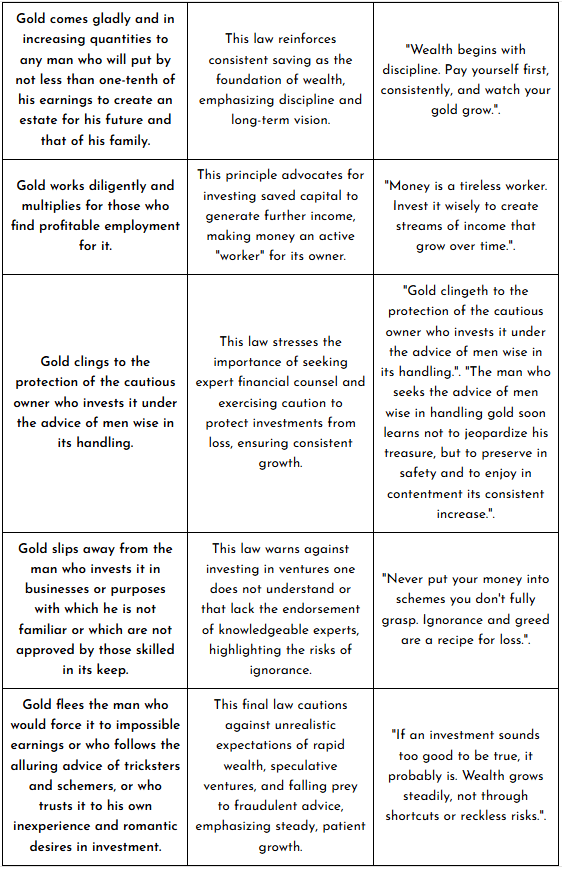
The Five Laws of Gold
Old Kalabab initiates a philosophical discussion by posing a question to his men: if given a choice between a large bag of gold and a tablet inscribed with wisdom, which would they choose? All the men opt for the gold, a choice Kalabab critically likens to the behavior of “wild dogs” who only feed for today without concern for tomorrow. Kalabab then recounts the cautionary tale of Nomasir, Arkad’s son, who initially squandered his inheritance but ultimately rebuilt his wealth by diligently applying the wisdom passed down by his father. This chapter introduces the “Five Laws of Gold,” which serve as critical principles for the preservation and strategic growth of accumulated wealth, complementing the “Seven Cures” for initial accumulation.

The Gold Lender of Babylon is a parable that explores the complexities of managing wealth within social relationships, particularly requests for loans. Rodan, a suddenly wealthy spear-maker, seeks counsel from Mathon, a seasoned lender, on handling pleas from friends and family. Mathon imparts crucial wisdom on distinguishing genuine need worthy of assistance from requests that enable financial irresponsibility. He stresses the importance of prudent lending practices, including securing loans with collateral and rigorously assessing the borrower’s character and the purpose of the loan. It delineates principles for Prudent Lending and Borrowing, emphasizing the difference between Helping vs. Enabling. Mathon advocates protecting one’s capital while potentially aiding others.
“If you desire to help thy friend, do so in a way that will not bring thy friend’s burdens upon thyself”
And underscores the necessity of Collateral and careful evaluation of the borrower’s reliability and the viability of their venture – “Better a little caution than a great regret”. It also warns against lending to those living beyond their means solely for appearances. Wealth management extends beyond personal accumulation to include responsible stewardship and navigating social obligations without compromising financial security.
The Walls of Babylon: Set against the backdrop of a siege, this parable employs the literal, imposing walls of Babylon – which safeguarded the city’s immense wealth from external threats – as a powerful metaphor for the necessity of protecting one’s financial resources. It argues that just as the city’s prosperity depended on its defenses, individuals must erect safeguards around their capital. Protection of Assets is Paramount. This encompasses various strategies: adequate insurance against unforeseen disasters, diversification to mitigate risk, utilizing sound legal contracts, and maintaining vigilance against fraud, theft, or poor investments that could lead to loss. Financial security, like civic security, requires proactive defense.
“We cannot afford to be without adequate protection… Behind strong walls, civilization will endure… Behind strong walls, our treasures shall be safe.”
The Camel Trader of Babylon presents a powerful cautionary tale and redemption arc through Dabasir, a former slave who recounts his descent into debt slavery due to reckless spending, living beyond his means, and ignoring sound financial principles. His arduous path back to solvency and freedom exemplifies the application of Arkad’s cures under duress. It involves extreme self-discipline, relentless hard work, transparent honesty with creditors about his repayment plan, and a rigorous, prioritized budget allocating specific portions of income to savings, living expenses, and debt repayment. The parable provides a blueprint for Escaping Debt Slavery, stressing Honesty with Creditors, Rigorous Budgeting and Prioritization, and unwavering Discipline. Crucially, Dabasir applies the “First Cure” (saving 1/10th) even while repaying debts, demonstrating that saving is non-negotiable regardless of circumstances – “I found I could get along just as well on nine as ten”. He learns that true wealth is sustainable income, not fleeting cash.
“A man’s wealth is not in the coins he carries in his purse; it is the income he buildeth… that which keepeth his purse full.”
The Luckiest Man in Babylon – Sharru Nada’s autobiographical account to his nephew contrasts two responses to adversity. Beginning as a slave, Sharru Nada achieved freedom and immense wealth through an unwavering commitment to relentless hard work, taking initiative, mastering a valuable craft (weaving), focusing exclusively on profitable effort, taking full responsibility for his situation, and persevering against all odds. His foil, Arad Gula, who shared the same starting point and opportunities, failed due to laziness, passivity, and blaming others. This parable powerfully reinforces the virtues central to both earning capacity and character: Hard Work as inherently dignifying – “Work, well-done, does good to the man who does it”. And Initiative – “I resolved that if there was anything to be done, I would be the one to do it”, Mastering a Valuable Skill, Focus on Profitable Effort, Taking Responsibility (rejecting victimhood), and Perseverance. It also emphasizes work ethic and integrity while employed (“If you work for a man, work for him…“). True prosperity stems not just from managing money wisely, but fundamentally from cultivating a strong character, a robust work ethic, and a proactive mindset. Circumstances can be overcome through determined action and value creation.
“The Richest Man in Babylon”: Your Initial Blueprint for Financial Security
Most profound insights, is that wealth building is fundamentally about character development. The story of Dabasir, who escaped debt slavery through discipline and methodical planning, shows that financial success requires consistent action and moral integrity, not just knowledge. Similarly, Sharru Nada’s rise from slavery to merchant wealth—while his fellow slave remained trapped by laziness—demonstrates that circumstances don’t determine destiny; character does.
“The Richest Man in Babylon” endures because it addresses the psychological and behavioral aspects of money management that transcend time and culture. The book’s emphasis on discipline, patience, and long-term thinking provides a powerful antidote to instant gratification culture. Babylon’s simple wisdom offers a reliable compass for navigating toward prosperity. Wealth is not about luck or inheritance, but the result of consistently applied principles within reach of anyone willing to embrace them. For those seeking financial wisdom, the ancient streets of Babylon offer a surprisingly modern roadmap—one that emphasizes character over cleverness, discipline over speculation, and time-tested principles over trendy strategies.
In a world of financial complexity, sometimes the oldest advice truly is the most valuable.
First published on என் நன்மொழி (WordPress).