
· Literary Review · Literary Review · Poem · Robert Frost
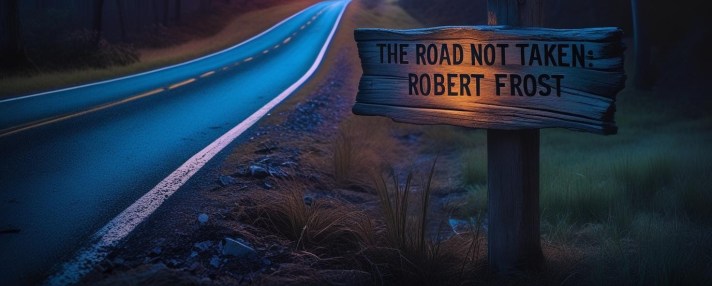
The Road Not Taken: Robert Frost
Robert Frost’s poem “The Road Not Taken” (1916) is a classic that has captured the attention of many readers and scholars. At first, it may seem to present a straightforward message about making choices and being independent. However, a deeper literary and psychological look shows that the poem explores the complexity and ambiguity of decision-making, the feelings that follow those decisions, and the human tendency to find meaning in personal choices.
The Road Not Taken
Two roads diverged in a yellow wood,
And sorry I could not travel both
And be one traveler, long I stood
And looked down one as far as I could
To where it bent in the undergrowth;Then took the other, as just as fair,
And having perhaps the better claim,
Because it was grassy and wanted wear;
Though as for that the passing there
Had worn them really about the same,And both that morning equally lay
In leaves no step had trodden black.
Oh, I kept the first for another day!
Yet knowing how way leads on to way,
I doubted if I should ever come back.I shall be telling this with a sigh
Somewhere ages and ages hence:
Two roads diverged in a wood, and I—
I took the one less traveled by,
And that has made all the difference.
The poem is set in a “yellow wood”(an autumnal landscape, a specific seasonal detail not merely decorative; rather, it becomes a pivotal element in the poem’s central dilemma, as the fallen, yellowing leaves, blanketing both diverging paths, serve to obscure any definitive evidence of prior passage. This natural carpeting renders the subtle distinctions between “the one less traveled by” and its equally leaf-strewn counterpart virtually indiscernible to the lone traveler, thus undermining any clear visual cue of wear or disuse. Consequently, the “yellow wood” transforms from a simple setting into a profound symbol of the inherent ambiguity of life’s choices, where the paths forward often appear equally untrodden, leaving the burden of distinction entirely to the chooser’s perception.) during autumn. The poem’s protagonist arrives at a fork in the road—a well-known image for a crucial decision. Both paths appear “just as fair,” and later are revealed to be “really about the same,” even though one path first seems to be “grassy and wanted wear.” This ambiguity challenges the familiar interpretation that the speaker made a dramatically unconventional choice, suggesting instead that people often create narratives that give more significance to their decisions than they may actually deserve. Near the end of the poem, the speaker says:
“I shall be telling this with a sigh
Somewhere ages and ages hence:
…I took the one less traveled by,
And that has made all the difference.”
The “sigh” can be interpreted in several ways—such as nostalgia, regret, or self-comfort. The speaker imagines recounting this choice in the future, reflecting a common human trait: the desire to add meaning and coherence to life experiences, especially those involving choices.
Philosophers, especially existentialists like Sartre and Camus, have focused on the idea that people are responsible for creating meaning in their own lives, even when it comes with the burden of uncertainty. Sartre famously wrote: “Man is condemned to be free… What is meant by that is, once thrown into the world, he is responsible for everything he does.” Frost’s line “way leads on to way” echoes Sartre’s notion that choices lead to other choices, leaving no room for turning back. Paul Ricoeur, another philosopher, has argued that people make sense of their lives through stories. He states: “Human life is rooted in narrative. We come to know ourselves through the stories we tell of the roads we have traveled.” In the poem, the traveler imagines telling the story with a sigh, not necessarily because the chosen path made “all the difference,” but because people naturally seek to find or create meaning in their past decisions.
Psychologist Leon Festinger developed the concept of cognitive dissonance, which suggests that when people feel uncomfortable about their choices or actions, they alter the way they think about them to restore comfort. Carol Tavris and Elliot Aronson elaborate on this: “We are not only rational beings, but also rationalizing beings. After we make a decision—especially an irreversible one—we usually reduce any lingering doubts by focusing on the positive features of our choice and the negative features of the rejected option.” In Frost’s poem, the narrative of having taken “the one less traveled by” may be an example of post-decision rationalization—a way the speaker lends significance to what might have simply been an arbitrary decision. The psychological principle of counterfactual thinking—wondering “what if?”—as studied by Daniel Kahneman and Amos Tversky, also applies. Barry Schwartz explains: “Regret is conjured by comparing what is to what might have been. Most regrets reflect failures of action rather than inaction—yet the possibilities multiply with every road not taken.” When the speaker admits, “I doubted if I should ever come back,” it reveals an understanding that choices are often final, and that paths not chosen recede into permanent possibility and regret.
Many modern self-help authors use Frost’s poem to urge readers to stand out and make bold choices. Simon Sinek, for instance, writes: “You have to do what nobody else is doing, to go where nobody else is going. That’s how you make a difference.” However, Frost’s poem actually points to the possibility that paths may not be as different as they seem. Mark Manson acknowledges this in his work: “We rarely know the real impact of our choices until long after we’ve made them. Much of the meaning we find in our lives is constructed in hindsight, not discovered in the moment.” While the “road less traveled” idea can be motivating, Frost is also cautious, even skeptical, about whether people can ever truly know the effects of their decisions.
“The Road Not Taken” is far more than a celebration of rugged individualism. The poem offers a thoughtful and psychologically astute meditation on choice, regret, and the personal stories that give those choices meaning. It reminds readers that although everyone must make decisions and live with them, the true significance of these choices is often constructed after the fact, and uncertainty and second-guessing can never be fully avoided.
5 minutes read time
First published on என் நன்மொழி (WordPress).